

ON THE FARM
New in the shop this week we have dried comfrey root and comfrey starts, as well as native golden currant, black currant, sochan, and flowerburst fruitbowl yarrow.
More on comfrey and sochan in the permaculture landscape:
Green-headed Coneflower, Sochan
“This sweet plant is a permaculture poster child as it is an easy to grow perennial native, beautiful, medicinal, and edible. From Steamboat Springs to New York City, the mountains of North Carolina and the banks of the Mackinaw River, I have been blessed and nourished to be in the presence of this wondrous and giving green friend.”
(Source: Chestnut School of Herbal Medicine, 2023)
_____
Comfrey: Believe the Hype!
“Perhaps you’re interested in growing comfrey to feed your animals, for medicine, for mulch, for compost or you’re slightly masochistic and want to roll around naked in the pricky beds of biomass (not me). In any case, here’s how to do it.”
(Source: Balkan Ecology Project, 2016)
Rod’s House
Just two more weeks to go in our cooking season.
Then we shift our focus back to growing.
 Nona’s hot buttery rolls. I wish you could smell these!
Want to work at Rod’s House?
They’re currently hiring.
LOCAL
Soil to Sky CSA Subscription
“We will be growing around 40 varieties of vegetables for the 2026 season. You can expect all of the familiar standards, like lettuce, cabbage, carrots, and broccoli, but you will also receive some veggies you may never have heard of. We hope to introduce people to the wonderful diversity of food available in today’s market. Don’t worry, we’ll post recipe ideas and preparation advice for all of our more unique produce so you’re not left wondering what to do with it!“
_____
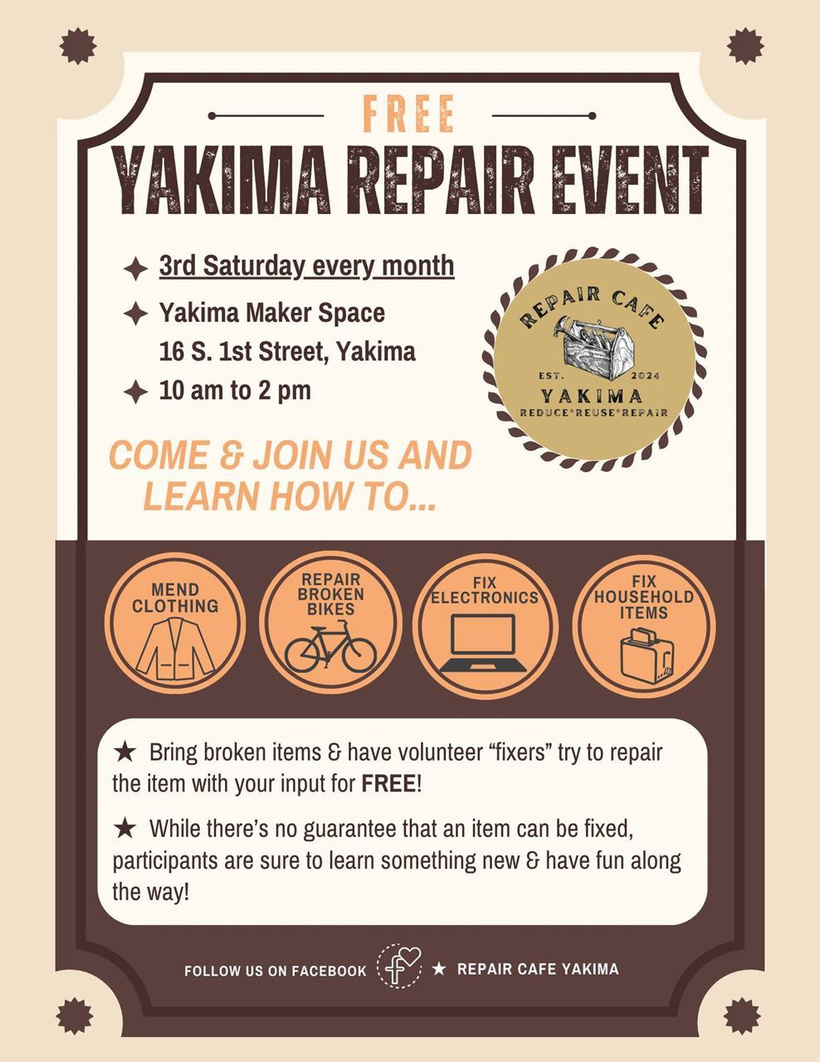
Repair Cafe: Bikes!
This month’s Repair Café Yakima will feature a Bicycle Repair Clinic at Yakima Makerspace from 10 a.m. to 2 p.m. on Saturday, March 21.
WA STATE
Repair Economy Washington
“Mend it. Make it. Fix it. Share it!
Need something fixed? Want to borrow a drill or learn to use a 3D Printer?
Or maybe you’re looking for reused supplies for a project?
Select a category from the dropdown menu to find repair services, community fix-it groups, tool libraries, makerspaces, creative reuse hubs, and reclaimed building materials near you!”
(Source: Repair Economy Washington)
_____
Made in Washington: Neil’s Bigleaf Maple Syrup
“When we started, there was no way it could be done. I heard this from so many people,” McLeod said. “Not enough sap in the trees, not enough sugar in the trees. The list goes on and on.”
(Source: King5 News, March 17)
_____
Got cheese? Creamery in northeast Washington debuts curds with Spokane-flavored blends, aiming to expand cheese production while cutting back on milk
The Columbia Community Creamery has added cheese production to its line of dairy products after months of brainstorming. Thomas, co-owner of Clover Mountain Dairy, said since it started two weeks ago, the nonprofit now has different flavored curds, with unique seasoning blends coming from Spiceology, a locally owned business in Spokane.
(Source: The Spokesman Review, March 18)
_____
JOB: Evaluation Alliance for Human Rights Coordinator at International Rescue Committee
“The International Rescue Committee (IRC) responds to the world’s worst humanitarian crises, helping to restore health, safety, education, economic wellbeing, and power to people devastated by conflict and disaster. Founded in 1933 at the call of Albert Einstein, the IRC is one of the world’s largest international humanitarian non-governmental organizations (INGO), at work in more than 40 countries and 29 U.S. cities helping people to survive, reclaim control of their future and strengthen their communities. A force for humanity, IRC employees deliver lasting impact by restoring safety, dignity and hope to millions. If you’re a solutions-driven, passionate change-maker, come join us in positively impacting the lives of millions of people world-wide for a better future.“
(Source: International Rescue Committee, March 19)
NATIONAL & BEYOND
More than 2,000 tiny dams are turning a Mexican ranch green
“Bours Muñoz began experimenting nearly two decades ago with mini dams for water harvesting.
She now boasts an abundant resource on a ranch that is fully off-grid for power and water resources. And her precious crop of freshwater is not just vitalizing her land. It’s benefiting neighbors beyond her property lines and inspiring others to follow her strategy.”
(Source: Yale Climate Connections, March 9)
_____
62 MIN LISTEN: Measuring Regeneration: Beyond data and metrics
“The question of HOW to measure regeneration also contains many sub-questions, such as what is the end goal? When does the timeline for measurement start and stop? What tools and resources are available for measuring? Where do we set the parameters for observation? I mean, is it just the ecology of the farm that needs improvement, or do we need to look at the economy of the farm business and the state of health of the people involved and the community around them?
It’s also very important to ask why we’re bothering to measure this at all. Who gets the data? What are they going to do with it, and how will this information affect the relationship between farmers, policy makers, and the end customer?“
(Source: Regenerative Skills, March 19)
_____
A fourth-generation farmer’s journey toward sustainability
“’Now we’re planting into 5- or 6-foot-tall cereal rye, triticale, hairy vetch — we have diverse cover crops, including a 12-way mix in some fields.” They also plant sunflowers after wheat. ‘It’s always different, especially in the last seven years.’
It’s all about education and building knowledge from others, reading articles and doing research on your own farm, he advised.”
(Source: Farm Progress, March 12)
_____
Imagining Feminist Technology Through Trajectories Rooted in Care and Inclusive Futures
“In her classrooms and community labs, this philosophy appears in small, radical gestures in debugging circles where failure is collectivised; code reviews that begin not with error‑spotting but with asking students what they were trying to make; installation rituals that treat onboarding as belonging rather than gatekeeping. Sankholkar calls these ‘micro‑protocols of inclusion,’ but their implications are architectural. They foster a counter‑normativity in which marginalised youth learn to trust intuition as much as logic, to see abstraction not as an obstacle but as a language they already speak. Her pedagogy refuses the scarcity mindset that tells underrepresented technologists to be grateful for any seat at the table. Instead, she invites them to imagine and build tables calibrated to their needs, where friction is minimised not for efficiency but for dignity. In doing so, she transforms care from sentiment into a replicable pattern, a design grammar for the next generation of technologists who understand that infrastructure begins with how we treat each other.”
(Source: GenderIT, March 17)
_____
What Does Water Want?
“Rather than forcing water to do what we want, what if we start asking what it wants?”
(Source: Bioneers, Feb 28)
_____
How the Chicken Crossed the Road to Build a Regenerative Food System
“Visionary agricultural innovator Reginaldo Haslett-Marroquin unearths a startling natural-world template for building a global movement that puts the chicken at the heart of bioregional food systems. These Poultry-Centered Regenerative Agroforestry farms can both renew the land and ultimately support the hundreds of millions of small farmers who produce 70% of the world’s food.”
(Source: Bioneers, March 11)
_____
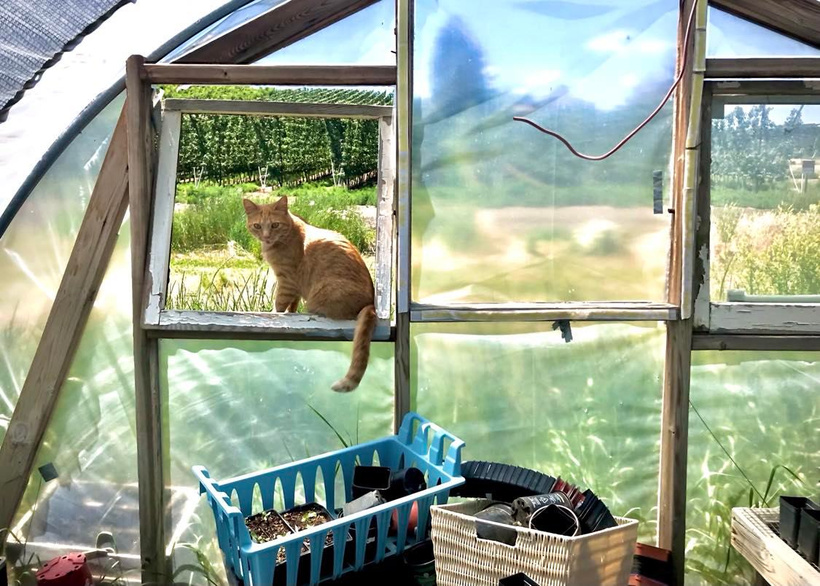
Happy vernal equinox, folks!
May your spring be regenerative and nutrient dense.
XO,
Maria



Leave A Comment